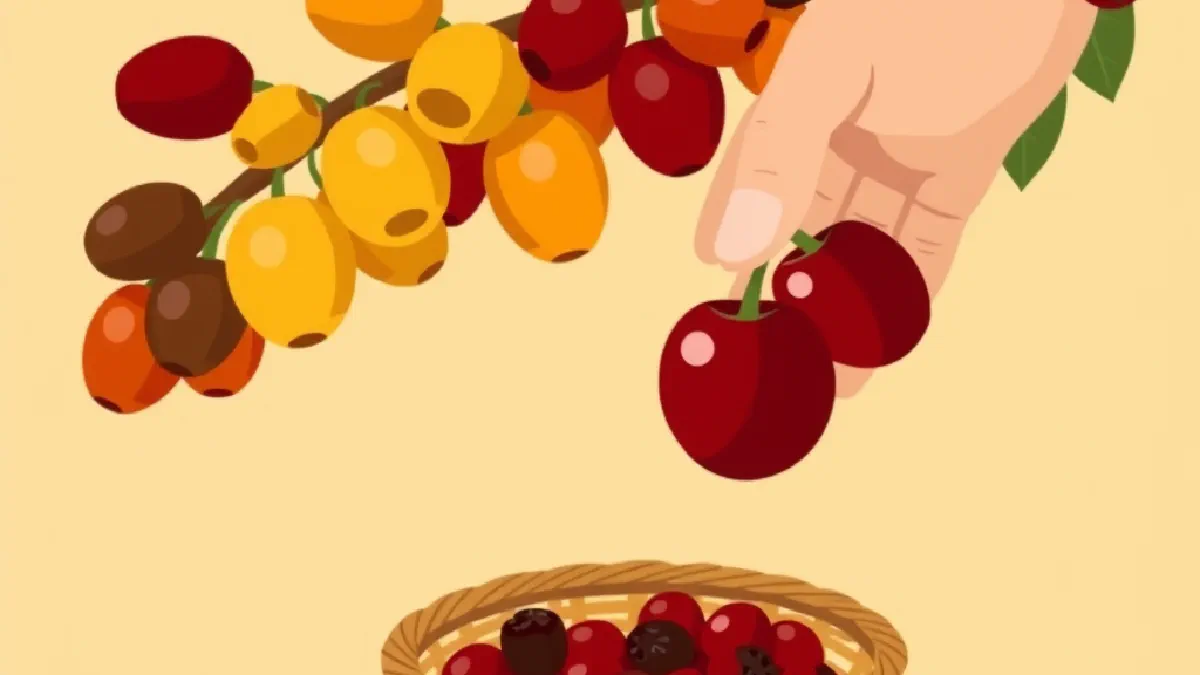
The Decision Nobody Tastes But Everybody Drinks
Roasting gets the credit and processing gets the blog posts, but the first real quality decision on a coffee farm is simpler than either: which cherries come off the branch.
A coffee branch does not ripen all at once. On the same stem, on the same day, you will find hard green fruit, yellow fruit halfway there, deep red fruit at its peak, and a few raisined ones that hung on too long. Someone has to decide what to take. That decision sets a ceiling on everything a roaster can do later — nobody has ever roasted the green out of an underripe bean.
Why Ripeness Matters So Much
The sugar in a coffee cherry is what feeds fermentation during processing and what eventually becomes sweetness and caramelisation in the roast. Underripe fruit simply does not have enough of it.
- Underripe cherries taste green, vegetal, grassy or sourly astringent. They are the single most common cause of a bag that tastes thin and harsh for no obvious reason.
- Ripe cherries carry the sugar and acid balance you actually want. Farms chasing quality measure it with a refractometer, aiming for roughly 18–22 Brix in the pulp.
- Overripe cherries go raisined and ferment-heavy, which can read as boozy or vinegary in the cup.
There is a second reason beyond flavour: uniformity. When every cherry in a batch has about the same sugar content and the same thickness of mucilage, fermentation behaves predictably and the whole lot tastes consistent. Mixed ripeness is why one scoop from a bag can taste different from the next.
Quality-focused farms sort for it more than once — at picking, then by floating the cherries in water (underripe and damaged fruit floats), and sometimes a third time by hand on the drying beds.
The Three Ways Coffee Gets Picked
| Method | How it works | Ripeness control | Where you see it |
|---|---|---|---|
| Selective picking | Pickers take only ripe cherries by hand, returning to the same tree several times over weeks | Highest | Most specialty coffee: Ethiopia, Kenya, Colombia, Central America |
| Strip picking | The whole branch is stripped in one pass, ripe or not, onto cloths below | Low — sorted later | Brazil, lower-grade lots, steep farms racing weather |
| Mechanical | A harvester straddles the row and shakes fruit off with rotating mallets | Low — sorted later | Brazil, where the land is flat enough to drive on |
Selective picking is the expensive one. A picker may walk the same tree four, five or six times across a harvest that runs for months, taking only what is ready that week. It is slow, it is almost entirely manual labour, and it is the reason good coffee costs what it does. It is also why steep, high-altitude farms — where a machine could never drive — tend to produce the coffees that score well.
Strip and mechanical picking are not automatically bad. They are a different strategy: harvest fast, then sort hard afterwards with water channels, density tables and optical sorters. Brazil leans on them because its terrain is flat and its labour is comparatively expensive, and Brazil still produces plenty of good coffee (see Brazil ). Growers there typically strip when about three-quarters of the crop is ripe, accepting the rest as something to sort out later.
The honest summary: selective picking raises the ceiling, sorting raises the floor.
Harvest Seasons: Coffee Has a Crop Year
Wine drinkers think in vintages. Coffee drinkers mostly do not, and they should — green coffee is an agricultural product that slowly fades in the bag. A coffee that has sat in a warehouse for eighteen months loses its brightness and starts tasting flat and papery, no matter how well it is roasted.
Because producing countries sit on both sides of the equator, something is always being picked somewhere:
| Origin | Main harvest | Roughly when it reaches roasters |
|---|---|---|
| Ethiopia | October – January | Winter into spring |
| Kenya | October – December (plus an early crop April – July) | Early in the year, and again mid-year |
| Colombia | October – December, plus the mitaca fly crop April – June | Available close to year-round |
| Guatemala | October – April, peaking December – March | Late winter into spring |
| Costa Rica | November – February, later at the highest farms | Early spring onward |
| Brazil | May – September | Late summer into autumn |
| Sumatra | April – May, with a second pass from September | Mid to late year |
Allow roughly three to six months between picking and the coffee reaching a roaster in the US. Milling, dry-milling, shipping and customs all take their turn, so a coffee picked in Ethiopia in November is a perfectly normal thing to be drinking the following spring.
How to Use This When You Buy
- Treat the harvest table as a freshness check. If it is November and a shop is still pushing last year’s Kenyan main crop, that coffee is a year old as green before it was even roasted. Ask when it landed.
- Follow the hemisphere. Early in the year, African and Central American coffees are at their best. Later in the year, Brazil and Indonesia are the fresh ones. Buying seasonally is the cheapest quality upgrade there is.
- Read “hand-picked” as a real claim, not marketing. On a transparent roaster’s page it usually sits alongside the farm name, elevation and harvest month. If none of that is there, the phrase means little — see how to read a coffee bag .
- Do not confuse harvest date with roast date. They are two different clocks and you want both to be recent. The roast-date one is covered in freshness and storage .
- Blame the farm before you blame your grinder. A persistently green, hay-like bag across several brew recipes is usually underripe fruit, not your technique.
The Short Version
Coffee quality is decided earlier than most people think. Picking only ripe fruit costs a great deal of labour and is the foundation of nearly every coffee you have ever loved; picking everything at once and sorting later is cheaper and can still produce a sound, pleasant cup. Knowing roughly when each origin is picked turns a bag’s origin into useful information about how fresh it is likely to be — and that single habit will improve your coffee more than most gear purchases.