The Names You Keep Seeing
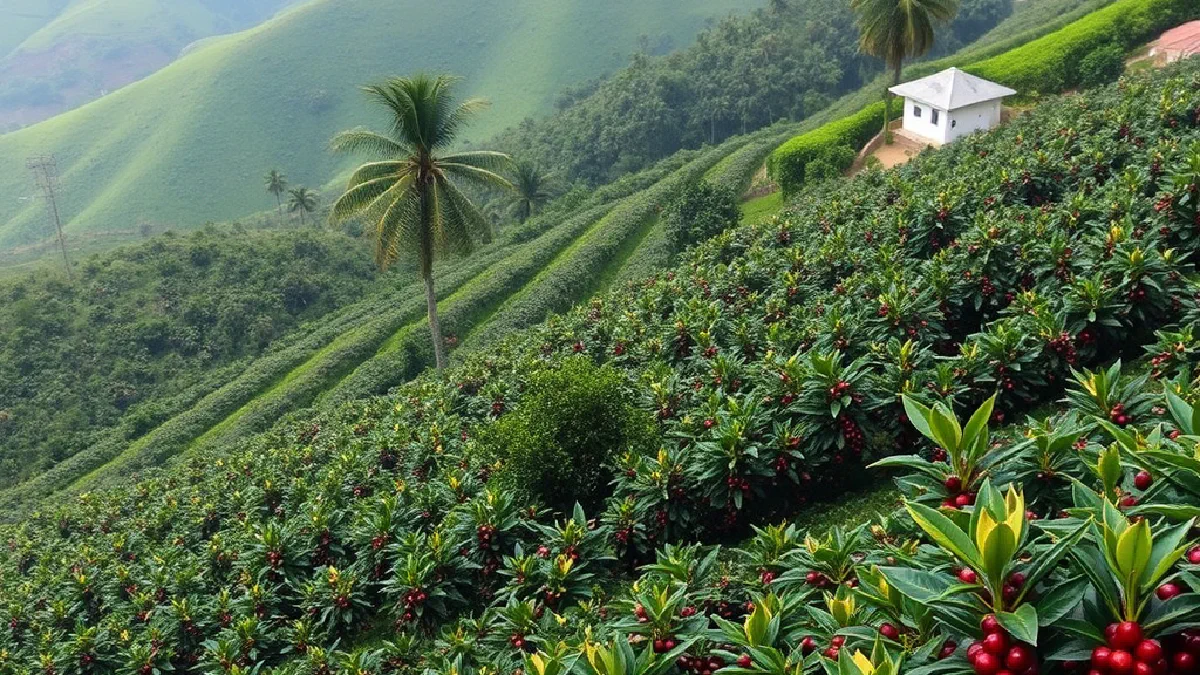
Buy enough Colombian or Central American coffee and the variety line on the bag stops saying Bourbon or Caturra and starts saying Castillo, Catimor, Sarchimor, Lempira or Cenicafé 1. These are not obscure boutique selections. Castillo alone is planted on roughly 40% of Colombia’s coffee farms, and about 87% of Colombia’s coffee area is now planted with rust-resistant varieties — up from 35% in 2010.
So if you drink Colombian coffee, you are almost certainly drinking one of these. It is worth knowing what they are, because the specialty world has spent fifteen years arguing about whether they taste as good as what they replaced.
One Fluke Tree in Timor
Every variety in this article traces back to a single plant.
In 1927, in a Typica plantation on what is now East Timor, someone found a coffee tree that should not have existed: a spontaneous cross between Coffea arabica and Coffea canephora (robusta). Arabica and robusta almost never cross successfully — different chromosome counts — so this was a genuine accident. It got the name Híbrido de Timor, or HdT.
What made it priceless is that it inherited robusta’s resistance to coffee leaf rust (Hemileia vastatrix), the fungus that has repeatedly wrecked Arabica crops worldwide, while cupping much closer to Arabica than to robusta.
From the late 1950s, seed went out to breeding institutes across the coffee world. Breeders crossed HdT back into good Arabica varieties, then backcrossed the offspring again and again, trying to keep the rust resistance while washing out the robusta flavour. Roughly 99% of rust-resistant Arabica varieties grown today descend from that one Timor tree.
The Three Families
Almost everything on a modern bag falls into one of three groups, defined by which Arabica parent was crossed with HdT.
| Family | Arabica parent | Bred by / when | What you’ll see on a bag |
|---|---|---|---|
| Catimor | Caturra | Portugal, 1959 | Catimor, Lempira, IHCAFE 90, Costa Rica 95, Anacafé 14 |
| Sarchimor | Villa Sarchi | Costa Rica / CIRAD–CATIE | Sarchimor, Marsellesa, Obata |
| Castillo | Caturra | Cenicafé, Colombia, released 2005 | Castillo, Castillo Tambo / Naranjal (regional selections) |
Catimor is the oldest and most variable family. It yields heavily and resists rust, but it is not a single uniform variety — there are dozens of Catimor lines, and they differ a lot. World Coffee Research rates Catimor types as capable of good quality above about 1,300 m, and as needing heavy fertilisation at lower elevations. The reputation problem in specialty coffee largely comes from low-grown, over-cropped Catimor, not from the family as a whole.
Sarchimor swapped Caturra for Villa Sarchi, a Costa Rican Bourbon mutation. Marsellesa, the best-known member, was released in 2009 by ECOM-CIRAD from a cross of Timor Hybrid 832/2 with Villa Sarchi CIFC 971/10. It is a dwarf, high-yielding tree with only intermediate rust resistance, and it is known in the cup for notably high acidity — which is exactly what makes it interesting for filter brewing.
Castillo is the one you will meet most. Colombia’s research centre, Cenicafé, spent 23 years and five generations of backcrossing Caturra with HdT before releasing it in 2005. Cenicafé also releases it as regional sub-selections (Castillo Tambo, Castillo Naranjal and others) matched to specific growing zones, and shipped a climate-adapted Castillo 2.0 in 2024.
Does It Taste Worse?
This is the actual argument, and it has been tested.
The Colombia Sensory Trial (2014–2015), run by CIAT, World Coffee Research and Kansas State University’s Sensory Analysis Center, compared Castillo and Caturra grown on the same farms and processed identically, scored by professional cuppers. The headline result: the two varieties scored similarly, and some Castillo samples cupped at 90+ points.
The researchers’ conclusion is the useful part for a buyer — the variety mattered less than the environment and the farm management. Altitude, soil, shade, picking selectivity and processing moved the score more than the genetics did.
That does not mean every cupper agrees. Plenty of experienced tasters still report that Castillo lots lack some of the aromatic complexity of a great Caturra from the same farm. But the blanket claim that rust-resistant hybrids cannot be specialty-grade does not survive the data.
What This Means When You’re Buying
Don’t treat the variety name as a quality grade. A Castillo from a high, well-run farm will beat a Bourbon from a mediocre one almost every time. The things on the label that actually predict the cup are altitude, roast date, process and the roaster’s reputation — see our guide to reading a coffee bag .
Watch the altitude number. This is where the hybrids genuinely differ. Catimor and Sarchimor types were bred to be productive at medium and low elevations, and that is where you find the thin, woody examples that gave them their reputation. Above roughly 1,500 m, with careful picking, they get good.
Expect a different shape, not a worse one. Broadly, these hybrids lean towards clean, sweet, structured cups with firm acidity rather than the heavy florals and syrupy body of a Gesha or an old-stock Bourbon . Marsellesa in particular is prized for acidity.
Brew them like any washed Latin American coffee. A medium roast and a 1:16 pour-over — 15 g coffee to 250 g water — is a reliable starting point. If the cup reads flat or papery, that is usually extraction rather than genetics; work through it with our dialing-in method .
There is a reason to root for them. Rust outbreaks have repeatedly wiped out harvests across Central America and Colombia . These varieties are a large part of why those farms still exist, and why there is still affordable Latin American coffee on the shelf.
The Short Version
Castillo, Catimor and Sarchimor are all descendants of one accidental Arabica–robusta cross found in Timor in 1927, bred to survive coffee leaf rust. They dominate Colombian and Central American production. On the evidence, a well-grown, high-altitude hybrid cups on par with the traditional varieties it replaced — so buy the farm, the altitude and the roast date, and let the variety name be trivia.